

Blog

Your blog category

Blog

What is the primary role of water retention agents in tile adhesives?

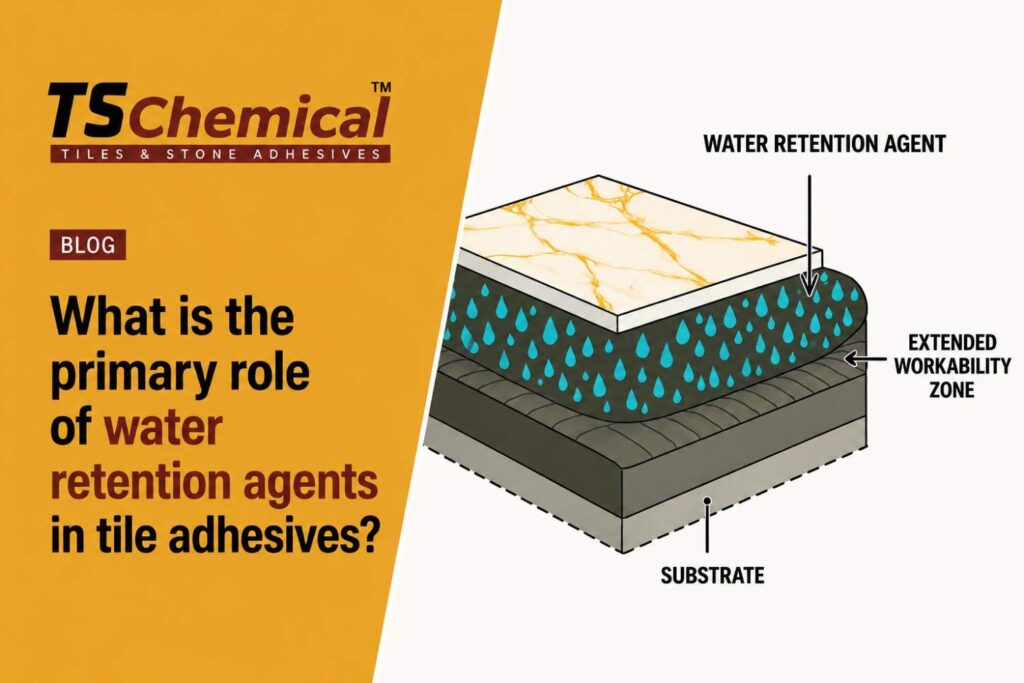
What is the primary role of water retention agents in tile adhesives? In the world of tile fixing, we often focus on the visible parts — beautiful tiles, neat joints, and clean finishes. But what truly makes tiles stay in place for years is something we don’t see: the adhesive. And within that adhesive, there’s a small but powerful component doing a big job — the water retention agent. Let’s explore what water retention agents are, how they work, and why they are essential for modern tile applications. Understanding the Basics: What is a Water Retention Agent? A water retention agent is a special ingredient added to tile adhesives to hold water within the mixture for a longer time. It ensures that the adhesive doesn’t dry out too quickly after being applied to the wall or floor. When moisture escapes too quickly, the adhesive loses its ability to hold the tile firmly in place. The water retention agent works like a moisture manager, keeping the mix smooth, workable, and strong enough to form a lasting bond. Why Water is Crucial in Tile Adhesives 2. Supports New-Age Materials Made as a dry mix, tile adhesive needs water to begin the bonding reaction that makes it stick strongly to surfaces. Water helps in: Making the mix soft and spreadable Giving time for correct tile placement Allowing a complete chemical reaction for bonding Preventing weak spots or hollow tiles   But here’s the problem: in hot weather, on dry surfaces, or when working outdoors, water can evaporate too fast. That’s where water retention agents step in. How Do Water Retention Agents Work? Imagine you’re applying tile adhesive to a concrete wall. The wall is dry and rough, and it quickly pulls water out of the adhesive. If this happens, the adhesive becomes dry and loses its grip before the tile is properly pressed. Water retention agents solve this issue by: Trapping water inside the adhesive layer Releasing it slowly over time Giving enough working time before the adhesive sets Ensuring the adhesive cures fully for a strong bond In simple words, they protect the water inside the adhesive until the job is done. What Materials Are Used as Water Retention Agents? Most water retention agents in tile adhesives are plant-based cellulose compounds. These include: HPMC (Hydroxypropyl Methylcellulose) HEMC (Hydroxyethyl Methylcellulose) Even though these ingredients are added in small amounts, they have a big impact. They are safe, natural, and widely used in modern tile adhesive formulas. 1. Extended Working Time With water held in the adhesive longer, workers get more time to: Spread the mix smoothly Adjust the tile position Ensure proper alignment and level This is especially important for large or detailed tiling jobs where accuracy matters. 2. Better Bond Strength When the adhesive doesn’t dry out too fast, it forms a stronger connection between the tile and the surface. This means fewer chances of: Loose tiles Cracks Detachment over time 3. No Need to Soak Tiles In the old method using cement mortar, tiles had to be soaked in water to stop them from stealing moisture from the mix. But with modern adhesives containing water retention agents, no soaking is needed, saving time and effort. 4. Effective in Hot and Dry Conditions Whether you’re working in summer or on a dry surface, water retention agents prevent premature drying. They give the adhesive time to do its job even under harsh conditions. 5. Uniform Finish Because the mix stays workable longer, it spreads evenly and avoids gaps or dry patches. This leads to a smooth, flat, and professional finish every time. Why It Matters in Modern Construction In today’s construction and design world, tiles are: Bigger and heavier More expensive Made from porcelain, glass, or natural stone Installed on tricky surfaces like drywall, wood, or metal These modern challenges require high-performance adhesives — and water retention agents are a key part of that performance. Without them, even the best adhesive can fail if it dries too early. What Happens Without Water Retention Agents? If a tile adhesive doesn’t contain a water retention agent, it may: Dry out before the tile is fixed Leave hollow spots under tiles Cause weak bonding Lead to early failure, especially in hot or dry weather This results in costly repairs, wasted material, and poor results. Final Words: Small Ingredient, Big Responsibility Water retention agents may not get much attention, but they play a crucial role in making sure your tile adhesive performs the way it should. They: Keep the adhesive moist long enough to work with Help tiles stay firmly attached Make modern tiling quicker, cleaner, and more reliable In short, they make strong tile bonding possible — especially in the fast, demanding, and stylish world of today’s construction. So the next time you see a bag of tile adhesive, remember: it’s not just powder inside — it’s carefully designed chemistry that includes a little hero called the water retention agent. Have a Question? TS Chemical delivers premium tile & stone adhesive solutions engineered for superior strength, durability, and long-lasting performance. Trusted by contractors, builders, and architects across North India, our products ensure reliable bonding for every application Please enable JavaScript in your browser to complete this form.Please enable JavaScript in your browser to complete this form.Full Name *Mobile Number *Email Address *City / LocationTopic (Blog Heading)Notes SUBMIT ENQUIRY
Blog

Tile Adhesive vs Cement Mortar: Which one is Better?

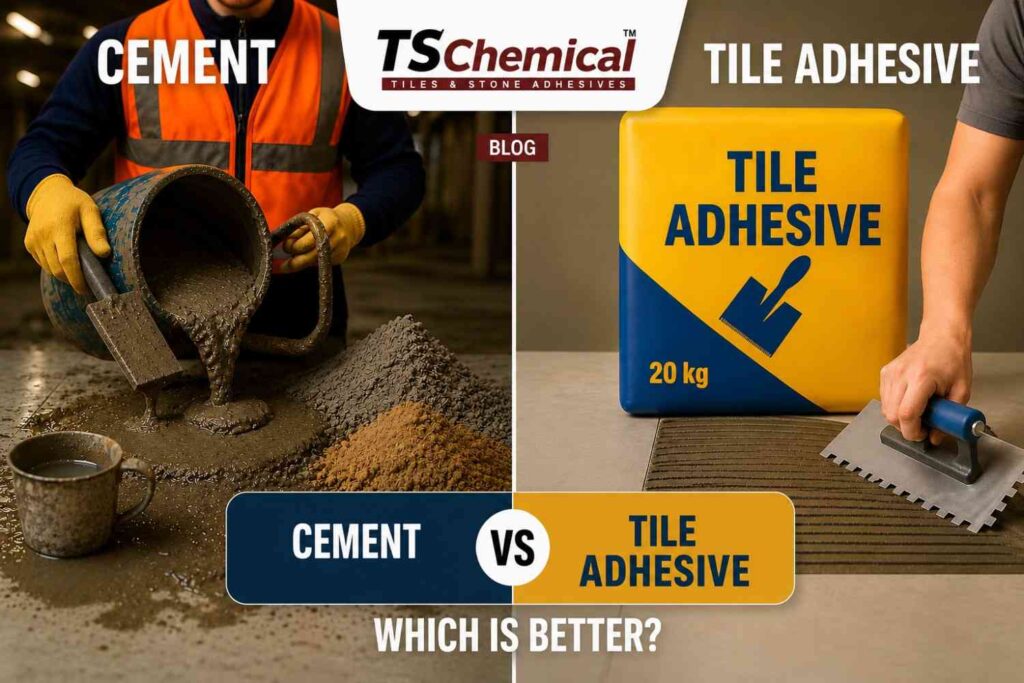
Tile Adhesive vs Cement Mortar: Which is Better? When it comes to fixing tiles—whether on floors, walls, kitchens, or bathrooms—the choice of the right fixing material is crucial. Two common options often come up: traditional cement mortar and modern tile adhesive. Though both do the job of sticking tiles, they work in very different ways. Let’s explore what each one is, how they perform, and why tile adhesive is becoming the smarter choice in today’s construction world. What is Cement Mortar? It’s made by blending sand, cement, and water into a thick paste used for sticking tiles. For decades, it has been used to attach tiles to surfaces. The process includes mixing cement and sand on-site, applying the paste on the floor or wall, and pressing the tile into place. It’s simple and inexpensive, but it comes with many challenges when it comes to precision, bonding strength, and long-term durability. What is Tile Adhesive? Tile adhesive is a pre-mixed bonding material made from cement-based polymers and special additives. It’s available in ready-to-use powder form—you just mix it with water. Tile adhesive is specially made to fix tiles quickly, evenly, and with a strong grip. It can be used for a wide range of tile types like ceramic, porcelain, stone, and glass, and is suitable for surfaces like concrete, drywall, or old tiles. How Do They Work? Cement Mortar: It holds tiles in place from underneath while slowly becoming firm. The mixture is applied unevenly by hand, often resulting in air pockets. It needs a thick layer for support—this adds weight and may lead to tile lippage (uneven tiles). Tiles must be dipped in water first to stop them from pulling moisture out of the mix. Tile Adhesive: It forms a firm and uniform grip that links the tile securely to the base It is applied with a notched trowel, creating a uniform bed and removing gaps. Requires a very thin layer, which reduces weight and improves finish. No need to pre-soak tiles; the adhesive is made to retain enough moisture. Head-to-Head: Cement Mortar vs Tile Adhesive Let’s compare the two based on the key aspects of tile fixing: Feature Cement Mortar Tile Adhesive Mixing Done manually on-site Pre-packed, easy to mix Bond Strength Moderate High Surface Preparation Needs rough surface Works on many surfaces Tile Soaking Must soak tiles No soaking needed Layer Thickness Thick (8–12 mm) Thin (3–5 mm) Coverage Low High (more area with less) Wastage High material loss Minimal waste Work Speed Slower Faster and cleaner Finish Often uneven Smooth and level finish Suitability Basic tiles only Works with all tile types Cost Over Time Cheaper now, costly repairs later Saves cost in the long run Why Tile Adhesive is Better for Modern Construction 1. Changing Tile Trends: Size & Weight Matters In the past, tiling was dominated by small-sized ceramic tiles (2×1 ft, ~3.2 kg) that could be securely fixed using cement. These were non-porous and lightweight, suitable for older, low-load designs. But today’s architecture embraces vitrified tiles — large-format tiles (up to 10×4 ft, ~45 kg) that are: Porous in nature Heavy in weight Difficult to hold with cement due to low bonding strength This shift makes traditional cement completely incompatible with new-generation tiles. 2. Limitations of cement in tiling Needs curing: Cement requires water curing to gain strength — something not feasible once a tile is laid Emits heat: Heat generated during setting can affect tile stability,causing cracks or debonding  No grip under tiles: Water slides off tile surfaces, leading to poor bonding and structural failure Climate issues: Cement-laid tiles often suffer from cracking, debonding, water ingress, and efflorescence under  temperature changes. 3. The Power of Adhesives: Strong. Smart. Polymer Grip. Modern tile adhesives are polymer-modified with water-retention agents, ensuring: Better moisture retention for optimum hydration Even heat distribution preventing cracks Superior bonding with both tile and substrate Zero curing required, saving time and labor This makes adhesives ideal for all surfaces — floors, walls, RCC slabs, underwater areas, plywood, metal sheets, and more. “Cement is past. Polymer is the future.” Common Myths & Facts  Myth: Adhesives are expensive.Fact: They may cost more per bag, but they cover more area with less product, reduce rework, and save time and labor. Myth: Mortar is stronger because it’s made of cement.Fact: Tile adhesives have engineered strength that’s specially formulated for bonding tiles under real-world conditions. Myth: Cement mortar is traditional, so it must be reliable.                                                                                                                                          Fact: Construction has evolved. Adhesives offer modern reliability for today’s materials and methods. Final Thought: Choose Smart, Build Strong The world of construction is changing fast, and your choice of material should match that pace. While cement mortar still has its place in some basic uses, tile adhesive is the clear winner when it comes to: Faster work Cleaner finish Greater strength More flexibility Fewer future problems If you want your tiles to last long, look great, and be installed with less mess and stress—tile adhesive is the way forward. Have a Question? TS Chemical delivers premium tile & stone adhesive solutions engineered for superior strength, durability, and long-lasting performance. Trusted by contractors, builders, and architects across North India, our products ensure reliable bonding for every application Please enable JavaScript in your browser to complete this form.Please enable JavaScript in your browser to complete this form.Full Name *Mobile Number *Email Address *City / LocationTopic (Blog Heading)Notes SUBMIT ENQUIRY
Blog

Why do you need adhesive?

What Is an Adhesive? A bonding agent connects different materials by creating a strong grip between them. It is also commonly called glue, paste, gum, or bonding agent. Adhesives can be liquid, paste, or solid forms, depending on their use. Instead of using screws, nails, or welding, adhesives can bond materials in a cleaner and faster way. Some adhesives are permanent, while some can be peeled or washed away easily. How Does Adhesive Work? Adhesives work using two main forces: Adhesion – This is the force between the adhesive and the surface it is applied to. Cohesion refers to the force that keeps the adhesive’s molecules connected to each other. “When both forces are strong, the adhesive forms a firm and lasting bond.” Example:When a tile is attached to a wall with the help of tile glue: – Adhesion holds the tile to the wall.– Cohesion keeps the adhesive strong and firm in between. If either force is weak, the tile may fall off. Instead of using screws, nails, or welding, adhesives can bond materials in a cleaner and faster way. Some adhesives are permanent, while some can be peeled or washed away easily. Types of Adhesives There are many different types of adhesives, and each has a special purpose. Here are a few common ones: Water-Based Adhesives – Made with water as the main ingredient. Safe and eco-friendly.Example: White glue used in schools. Solvent-Based Adhesives – Stronger and used in industries. Dry fast and are waterproof.Example: Adhesives used in furniture and footwear. Hot Melt Adhesives – Solid at room temperature but melt when heated.Example: Glue sticks in hot glue guns. Epoxy Adhesives – Come in two parts and must be mixed before use. Very strong and long-lasting.Example: Used in metal repairs, electronics, and construction. Tile Adhesives – Specially made for fixing tiles. Waterproof and strong.Example: Tile chemicals used in construction. Common Uses of Adhesive Around You You may not realize it, but adhesives are part of your everyday life: – Home: Tile work, furniture, wallpaper, kitchen fittings. Adhesives in the Tile Industry Modern Tiles Need Modern Solutions  Tile technology has advanced — today’s vitrified tiles come in larger formats like 10×4 or 6×4 feet. These tiles are heavier, more porous, and less compatible with traditional cement laying methods. Why Adhesives Are the Better Choice Polymer-modified adhesives are engineered for modern tile demands. They contain water-retention agents that: Maintain internal moisture Reduce heat buildup Ensure complete curing Provide high bond strength and greater flexibility. Can handle climatic changes and tile expansion without damage. Have a Question? TS Chemical delivers premium tile & stone adhesive solutions engineered for superior strength, durability, and long-lasting performance. Trusted by contractors, builders, and architects across North India, our products ensure reliable bonding for every application Please enable JavaScript in your browser to complete this form.Please enable JavaScript in your browser to complete this form.Full Name *Mobile Number *Email Address *City / LocationTopic (Blog Heading)Notes SUBMIT ENQUIRY

Blog

Why adhesives are important in modern construction?

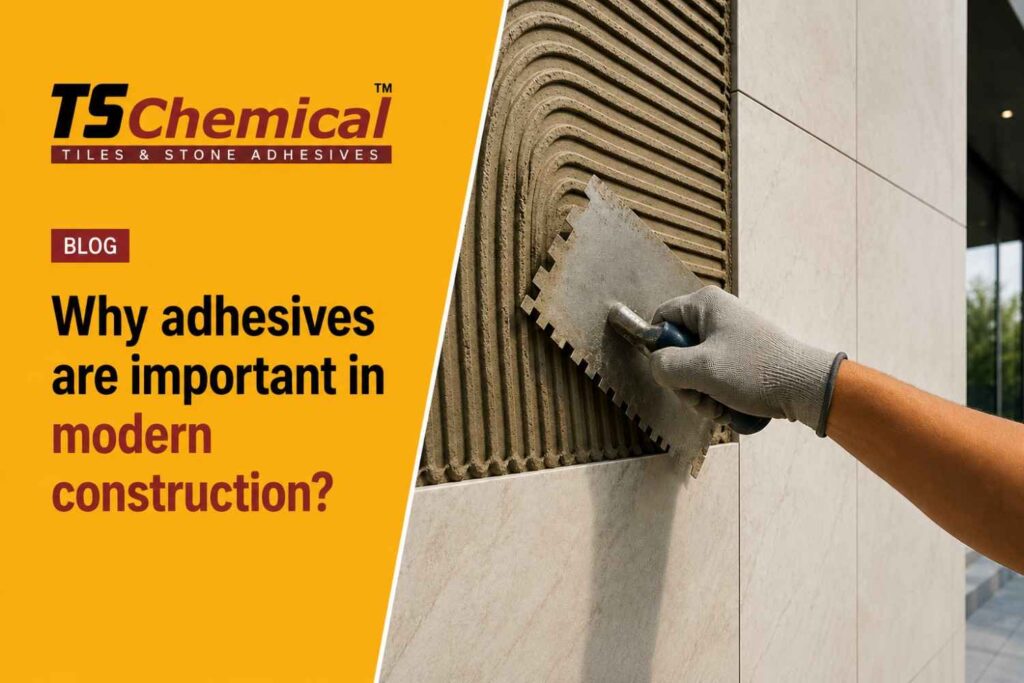
How Do Adhesives Work? Adhesives stick by forming a tight connection at the surface of the materials. This is done through two types of forces: Surface grip – “It seeps into small spaces on the surface, holding on tightly like a perfect fit.” Chemical connection – Some adhesives form a strong chemical link between the glued surfaces, making the bond even stronger. Once the adhesive sets (dries or cures), it becomes a strong holding force that keeps materials together through weight, pressure, or temperature changes. Why Are Adhesives So Important in Today’s World? In today’s fast-paced and style-driven construction world, adhesives do much more than just stick things. Here’s why they matter so much: 1. Modern Designs Need Invisible Fixing Modern homes and buildings often use sleek finishes—Metal, polished tiles, laminates. Adhesives offer a clean, hidden way to bond (Tiles & Stones) these surfaces without spoiling their look. No screws. No drill marks. Just smooth perfection. 2. Supports New-Age Materials Materials like acrylic, fiber panels, engineered wood and plastic laminates are widely used today. Most of these can’t be joined well with old methods. Adhesives are designed to work with these next-gen surfaces smoothly to fix tiles & stones on them. 3. Saves Time and Effort Unlike traditional fixing, which involves handling multiple materials, mixing them separately, and transporting them to the application area, using tile adhesive is quick and efficient. Just pour, mix, and apply directly on-site — and it’s done! In large construction projects, this significantly reduces labor hours and accelerates the overall workflow. 4. Better Durability and Flexibility Adhesives move slightly with surfaces. So when the weather changes, or materials expand or shrink, the adhesive holds them together without cracking. This flexibility adds life to the structure. 5. Reduces Weight and Cost Adhesives reduce the need for bulky materials, making structures lighter and easier to handle. In industries like interior design and furniture, this helps reduce material use and transportation costs. Where Are Adhesives Used in Construction and Design? Let’s look at some common places where adhesives play a silent but powerful role: Tile Fixing: Whether it’s bathroom walls or kitchen floors, tile adhesives help stick tiles securely and evenly. Types of Adhesives You Might See Today Depending on what they need to bond, there are different kinds of adhesives: Tile Binders – Made for wall and floor tiles; strong grip and water resistance. PU Adhesives – Best for transparent surfaces like glass and plastic. Sealants – Flexible fillers that block gaps and also act as adhesive. Each of these is made with a special formula to match the needs of today’s projects—weather-proofing. Final Thoughts: The Power of Something Invisible These new technologies mean that adhesives are not just tools—they are solutions that improve safety, speed, sustainability, and strength. You may not always see it, but adhesives are the reason your tiles don’t fall off, your shelves don’t shake, and your walls look seamless. In modern construction and design, they offer a combination of invisible beauty, strong performance, and smart efficiency. As the world continues to build higher, faster, and more creatively, adhesives are right there—quietly holding everything together. Have a Question? TS Chemical delivers premium tile & stone adhesive solutions engineered for superior strength, durability, and long-lasting performance. Trusted by contractors, builders, and architects across North India, our products ensure reliable bonding for every application Please enable JavaScript in your browser to complete this form.Please enable JavaScript in your browser to complete this form.Full Name *Mobile Number *Email Address *City / LocationTopic (Blog Heading)Notes SUBMIT ENQUIRY

Scroll to Top